
I’m going to say something that’ll annoy a few people in my industry: most SEO agencies in India are selling busywork disguised as strategy.
They’ll build you 30 backlinks from directories nobody’s visited since 2019. They’ll publish a few blogs stuffed with keywords in ways that make the sentences physically painful to read. They’ll send you a monthly report full of graphs that go up and to the right. And six months later, your phone still isn’t ringing.
That’s not SEO. That’s a ₹25,000-a-month subscription to feeling like you’re doing something about organic traffic while nothing actually changes.
I’m going to say something that’ll annoy a few people in my industry: most SEO agencies in India are selling busywork disguised as strategy.
They’ll build you 30 backlinks from directories nobody’s visited since 2019. They’ll publish a few blogs stuffed with keywords in ways that make the sentences physically painful to read. They’ll send you a monthly report full of graphs that go up and to the right. And six months later, your phone still isn’t ringing.
That’s not SEO. That’s a ₹25,000-a-month subscription to feeling like you’re doing something about organic traffic while nothing actually changes.

Here’s a number that puts it in perspective. Roughly 68% of online experiences begin with a search engine. In India, with over 800 million internet users, that’s a staggering amount of commercial activity starting with someone typing words into Google. And most startups are either ignoring it entirely (“we’ll do SEO later”) or doing it so badly they’d be better off not doing it at all.
The Collabers is a digital marketing and influencer collaboration platform based in India, and I’ve personally watched this pattern repeat with dozens of startups that came to us after burning through their first SEO budget. What we’ve figured out (sometimes by making the same mistakes ourselves, honestly) is that SEO in India has specific traps. Let me walk through them.
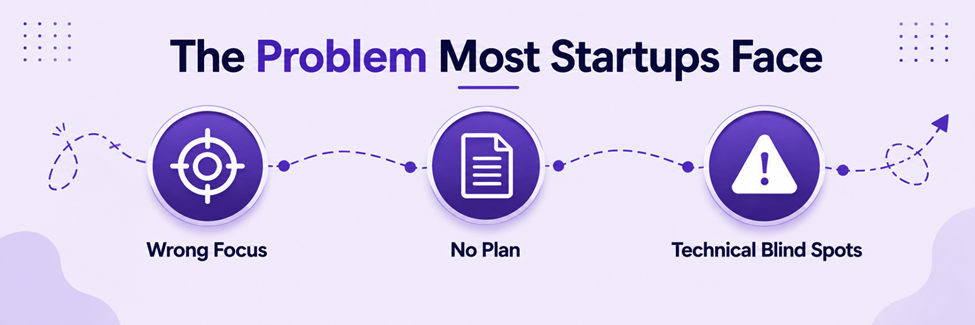
The Same Three Mistakes. Every Time.
I wish I could tell you the problems are varied and interesting. They’re not. It’s the same three things.
Chasing keywords you’ll never rank for. A health food startup wants to rank for “healthy snacks.” That keyword gets 74,000 searches a month. Every major FMCG brand in the country is sitting on it with domain authorities above 60 and content budgets larger than your annual revenue. Competing for that term with a six-month-old domain and a ₹30,000 monthly SEO budget? You won’t crash. You just won’t move. Not an inch. Not in twelve months.
The fix is uncomfortable but obvious: long-tail keywords with buying intent. “Best high-protein snacks for gym in Mumbai” gets maybe 800 searches a month. But the person typing that is ready to buy right now. And you can actually rank for it in 3 to 4 months. It’s less glamorous than ranking for “healthy snacks.” It’s also 100x more profitable.
Publishing content with no plan behind it. I audited a startup’s blog last quarter. Fifty posts. Total organic traffic from all fifty combined: twelve visits per month. Twelve. That’s a real number. The posts were about whatever the founder found interesting that week. No keyword research. No internal links. No idea who any of it was written for. It was content for the sake of content, and Google treated it exactly the way you’d expect.
Pretending technical SEO doesn’t exist. The unglamorous stuff. Slow page speed, broken links, missing schema markup, duplicate title tags across twenty pages, a robots.txt file that’s accidentally blocking half the site. I’ve seen all of these. More than once. On the same site sometimes. A technical audit should happen before a single blog post gets written. Not after you’ve published 40 articles and wonder why nothing’s ranking.

What a Real SEO Strategy Actually Looks Like
Let me walk through the timeline we use at The Collabers because I think it’s the clearest way to show how this is supposed to work.
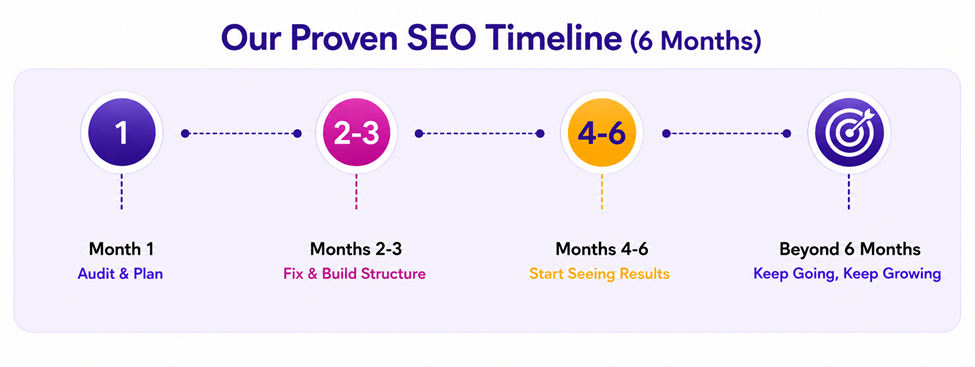
Month 1 is ugly. No writing. No link building. Just an audit and a plan. Technical audit, competitor analysis, and keyword mapping. Every target keyword gets mapped to a specific page (existing or to-be-created) and tagged with an intent label: informational, commercial, or transactional. This spreadsheet looks boring. It’s also the thing that makes months 4 through 12 work. Skip it and everything downstream is guesswork.
Months 2 and 3 are structural. Fix the technical issues (I’ve seen sites where the canonical tags were pointing every page to the homepage, which is like telling Google that your entire website is one page). Build the internal linking architecture. Optimise existing pages. Start the content calendar. You should be publishing 8 to 12 optimised articles per month if you’re serious. Less than that and there isn’t enough signal for Google to notice you exist.
Months 4 through 6 are when things start moving. Consistent publishing, strategic link building (not directories, but guest posts, digital PR, resource page links from real sites), and ongoing technical maintenance. Keywords start migrating from page 5 to page 2. A few hit page 1. Traffic curves start bending upward.
Most brands quit at month 3. That’s the trap. The worst possible time to quit is right before the compound effect kicks in.
The digital marketing team at The Collabers builds reporting around leading indicators (keyword position changes, crawl health, backlink growth) so clients can see the engine working before the traffic shows up. Because if all you’re watching is traffic and it hasn’t moved yet at month 2, you’ll pull the budget. Even though everything underneath is working exactly as it should.
Local SEO: The Easiest Wins Nobody’s Taking
If your business serves a specific area and you haven’t properly set up Google Business Profile, I genuinely don’t know what to tell you. It’s free. It takes an afternoon. And roughly 46% of all Google searches have local intent.
“Best digital marketing agency in Delhi.” “SEO company near me.” “Website developer in Bangalore.” People typing these are ready to hire someone today. Local SEO is how you appear in front of them.
The basics are simple but constantly botched: consistent name, address, and phone number across every directory. A Google Business Profile with real photos (not stock images, real ones). Regular posts. And reviews. Lots of reviews. A business with 47 Google reviews will almost always outrank one with 6, assuming everything else is roughly equal. Getting reviews isn’t complicated. Ask customers. Most will say yes if you make it easy.
What’s less obvious is how local and organic SEO feed each other. Your blog content targeting national keywords should include location-specific variants. “How to choose an SEO agency in India” is your pillar page. “SEO agency in Mumbai: what to look for” is a supporting page that links back to it. That structure tells Google exactly what you do and where you do it.
Content That Ranks vs. Content That Just Sits There
There’s a real difference and it’s not length. I’ve seen 800-word articles outrank 3,000-word guides because the short one answered the question better.
“Better” means more specific, more current, and more useful than what’s already on page 1. That’s it. That’s the bar.
Here’s a test I use before writing anything: search the target keyword, read the top three results, and ask myself what they missed. Maybe they’re all from 2023 and the data is stale. Maybe they explain the theory but skip the “here’s exactly how to do it” part. Maybe they’re written for beginners when the actual searcher is intermediate. That gap is your article.
The content ops team at The Collabers builds each piece around a keyword cluster (one primary, 3 to 5 secondary), maps internal links before writing starts, adds FAQ schema for AI search visibility, and runs every draft through a quality check. We also do something most SEO shops ignore: making sure the content is genuinely good to read. Nobody shares a blog post that sounds like it was assembled from a content template. Nobody links to it either. And without links and shares, rankings don’t last.
Frequently Asked Questions
How long does SEO take to show results in India? Measurable organic traffic growth usually starts between months 4 and 6. Competitive industries like fintech, edtech, and real estate can take 8 to 12 months. The timeline depends on your domain authority, competition level, and how much technical debt your site carries. If someone promises results in 30 days, they’re either lying or they mean something different by “results” than you do.
What should SEO services cost for an Indian startup? A credible engagement runs ₹25,000 to ₹1,50,000 per month depending on scope, competition, and whether content production is included. Be sceptical of “complete SEO” for ₹5,000 a month. That budget can’t cover a single well-researched blog post, let alone the technical work, link building, and strategy a real campaign needs.
Is SEO worth it when paid ads get faster results? Paid ads stop producing the moment you stop paying. SEO compounds. A blog post that ranks on page 1 for a commercial keyword generates leads every month for years without additional spend. The smart play is usually both: SEO as the long-term asset, ads handling immediate demand while the organic engine builds.
How do I know if my current SEO agency is doing a good job? Ask for three things: monthly keyword position changes (not just total traffic), a list of backlinks acquired with actual source URLs, and a technical health score. If they can’t provide all three, they’re probably not doing the work. You can also check Google Search Console yourself. It’s your data. Look at whether impressions and clicks are trending up.
Can I do SEO myself without hiring anyone? The basics, yes. Keyword research with free tools, writing optimised posts, fixing broken links, managing your Google Business Profile. But technical SEO, competitive link building, and ongoing strategy usually require specialist tools and experience. Most founders find that the time cost of DIY SEO exceeds what a good agency charges. Your time has a price too.
Making SEO Work, Not Just Exist
Three things separate startups that win at SEO from ones that just talk about it. First, they commit to a real timeline. Six months minimum, twelve to build serious momentum. Not “let’s try for two months and see.” Second, they treat every piece of content as a product with a specific job. Every article serves a keyword, a user intent, and a conversion goal. Third, they fix the foundations before stacking content on top. Technical health first. Blog volume second.
If your current SEO feels like it isn’t going anywhere, it probably isn’t. The Collabers works with startups and D2C brands across India to build SEO strategies that actually compound. Worth a conversation. Talk to our team and we’ll tell you exactly where your site stands before we pitch anything.